
I posed this question to four AI engines:
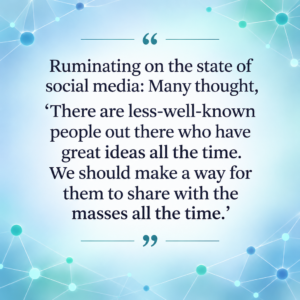
[“Ruminating on the state of social media: Many thought, ‘There are less-well-known people out there who have great ideas all the time. We should make a way for them to share with the masses all the time.'”]
Engine 1:
That was the founding pitch, and it wasn’t wrong on the surface.
The old gatekeepers—newspapers, networks, academic presses, publishers—really did filter for status, connections, and institutional taste as much as for quality. Opening the floodgates meant some genuine ideas that would have died in obscurity could reach people who needed them.
What the pitch underweighted was the mechanism that would actually decide what “the masses” see.
Once you scale distribution to everyone, all the time, the scarce resource is no longer publication slots; it’s attention. Platforms that survive do so by optimizing for whatever keeps people engaged, not for whatever is true, novel, or well-reasoned.
Great ideas do not reliably maximize that metric.
Outrage, status games, tribal signaling, short emotional hits, and low-effort imitation do.
So the same system that lets the obscure person with a sharp observation reach millions also lets ten thousand less-sharp observations, plus coordinated bad-faith ones, compete for the same feed.
The result is less “meritocracy of ideas” and more “tournament of attention.” Some of the people who win that tournament have worthwhile things to say. Many do not, and the selection pressure rewards the skills of audience capture over the skills of careful thought.
The original vision treated distribution as the hard problem; the harder problem turned out to be ranking under infinite supply.
Engine 2:
I think the premise was half right, and the half it got wrong explains most of what went sideways.
The part it got right: plenty of people outside the spotlight have good ideas, and the old gatekeepers (editors, publishers, conference committees) shut out many of them for reasons that had nothing to do with quality. Some of those people did break through. You can see it any day in the long tail of Substacks, livestreams and niche blogs where a practitioner explains something better than any vendor whitepaper does.
The part it got wrong was the diagnosis. It assumed distribution was the bottleneck. Once distribution became free, the bottleneck moved to attention, and attention doesn’t scale. Someone still has to decide what gets seen. That job moved from human editors, who were flawed but at least aimed at quality, to ranking algorithms that aim at a proxy: engagement. That’s Goodhart’s law in a pure form. Engagement was supposed to measure “this is valuable.” Once it became the target, the system learned to produce the cheapest thing that drives engagement, and outrage and novelty are much cheaper than insight.
Then there’s the phrase “all the time.” Great ideas don’t arrive on a schedule. They come out of long stretches of quiet work, much of it dull. A platform that rewards steady output pushes people toward volume, and volume squeezes out depth. So the people with real ideas end up either competing at a cadence that wears down the thinking or posting rarely and getting buried by the feed. Either way, the thing the system was built to surface becomes harder to find.
A data engineer might put it this way: we built a pipeline with huge ingestion throughput and no data quality layer, then put an optimizer downstream that rewarded the noisiest records. It did what we designed it to do. We just didn’t design it for what we said we wanted.
What prompted the rumination? Is this heading toward a post, or is it more about how you spend your own time on these platforms?
Engine 3:
That promise was the great Trojan horse of the digital age.
It was sold to us under the banner of democratization—the idea that the ivory tower of traditional media was collapsing, and that the common man, the local expert, and the grassroots visionary would finally have a seat at the table. We were told it would be a vast, digital agora where the best ideas would naturally rise to the top through the wisdom of the crowd.
Instead, we got the exact opposite: a system that weaponizes the lowest common denominator.
The problem wasn’t just the technology; it was the fundamental misunderstanding of human nature and the economic reality of the platforms themselves. When you remove the gatekeepers—the editors, the publishers, the local community leaders who at least nominally maintained standards of quality and discourse—you didn’t get a pure expression of democratic thought. You got an attention economy.
In an attention economy, “great ideas” are at a distinct disadvantage. A nuanced, carefully reasoned, or deeply researched argument requires patience, literacy, and cognitive effort to digest. It cannot compete with the dopamine-triggering effectiveness of outrage, vanity, tribal signaling, and spectacle. The algorithms, which were built to maximize engagement, were never designed to elevate truth or utility; they were designed to keep eyes glued to screens. Naturally, they learned to prioritize the content that triggers the basest instincts: fear, anger, and moral narcissism.
The “less-well-known people” who actually rise in this system are rarely those with the best ideas. They are those with the best profiles—those who understand how to game the algorithm, how to curate a persona, and how to ignite a digital mob. It turned the public square into a performance stage where the goal is not to inform, but to dominate.
We also have to reckon with the reality that social media destroyed the concept of local authority. In the past, you listened to the local pastor, the school teacher, or the community elder because their character was known to you. Now, your feed is populated by disembodied voices, often paid actors or foreign agitators, masquerading as grassroots “influencers.” This has led to the atomization of society, where people feel connected to millions of strangers but have lost the ability to build meaningful, face-to-face relationships with their neighbors.
Ultimately, the experiment failed because it assumed that humanity, left to its own devices without hierarchical structure or cultural gatekeeping, would naturally incline toward the good and the true. It turns out that without those boundaries, the mass of humanity trends toward the entropic, the chaotic, and the degenerate.
We are left with a landscape where the loudest, most divisive, and most unhinged voices are the ones who control the narrative, while the quiet work of building families, local communities, and actual, tangible institutions goes unrewarded by the machine.
The remedy isn’t to fix social media; the remedy is to turn away from it and pour our energy back into the real, physical, and local world where ideas can actually be tested against reality rather than just validated by likes.
Engine 4:
There’s a generous assumption tucked into that thought: Being unknown doesn’t mean you have nothing worth hearing.
I think that assumption holds up.
“All the time” is where things get interesting. Having a way to share an occasional great idea gradually becomes an expectation that you should always have something to say. Then an incentive to say whatever keeps people listening.
A person might have one extraordinary insight a year, grounded in decades of experience. Someone else might produce six provocative opinions before breakfast. A feed can give the second person far more attention.
We solved much of the problem of getting a thought published. Recognizing which thoughts deserve our time remains difficult.
And perhaps we underestimated how being rewarded for speaking would change what people choose to say.
How about you?
What do you think of the responses?
Which response resonates with you?
Which answers were supplied by which engine?
Let me know in the comments.
:{>

Comments